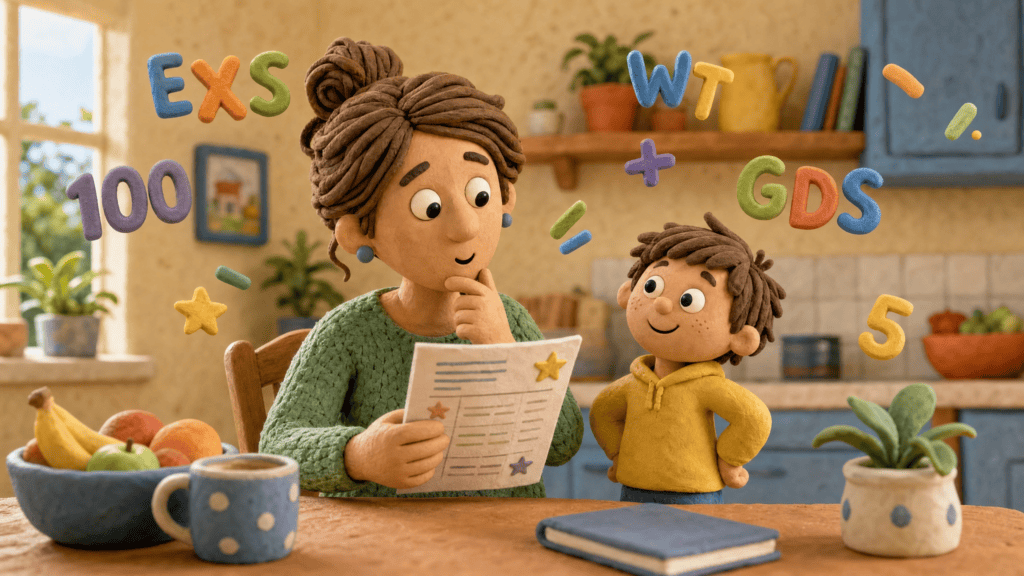
You open your child’s school report...
There’s a number — 97? 103? — followed by a string of mysterious abbreviations:
EXS. GDS. ARE. GLD. WT.
At this point, many parents do what parents across the country have quietly been doing for years:
open a new tab and start Googling.
You are absolutely not alone.
As teachers, we love an acronym. Honestly, we can turn almost anything into four capital letters. Somewhere along the line, school reports became filled with educational shorthand and parents were just expected to magically know what it all meant. (Sorry about that.)
So here’s a plain-English guide to understanding what school reports are actually telling you — and, importantly, what they aren’t.
In Year 2 and Year 6 SATs, children’s raw test scores are converted into a scaled score.
This helps make results fair nationally, because the difficulty of test papers changes slightly every year.
Here’s the key thing parents need to know:
It does not mean:
It simply means they met the nationally expected level for that year group.
In fact, children often only need around 50–70% of the paper correct (depending on the test) to achieve a scaled score of 100.
Scaled scores usually range from:
| Scaled Score | What It Generally Means |
|---|---|
| 110–120 | High attainment / greater depth |
| 100–109 | At or above expected standard |
| 90–99 | Slightly below expected standard |
| Below 90 | Significantly below expected standard |
Again, a score below 100 does not automatically mean something is seriously wrong.
It means your child is currently working below the nationally expected level for that age group — on one assessment, on one day.
And that’s important, because a scaled score only tells you a very small part of the story.
It does not measure:
A child can make brilliant progress across the year and still score below 100. Equally, some children score highly while still struggling in confidence day to day.
Most teachers care far more about progress than one isolated number.
Scaled scores are generally used in KS1 and KS2 for:
Writing is assessed separately by teachers.
No parent has ever opened a report and thought:
“Ah yes, EXS. Of course.”
So here’s the translation guide:
EYFS (Reception)
In Reception, children are assessed against the Early Years Foundation Stage (EYFS) goals.
You may see:
| Descriptor | Meaning |
|---|---|
| Emerging | Not yet meeting expected developmental goals |
| Expected | Meeting the goals expected for their age |
| Exceeding | Above expected level (used less commonly now) |
You may also hear:
GLD = Good Level of Development
This means a child has reached the expected level overall and is considered ready for Year 1 learning.
KS1 and KS2
From Years 1–6, schools often use these descriptors:
| Acronym | Meaning |
|---|---|
| WT | Working Towards |
| EXS | Expected Standard |
| GDS | Greater Depth Standard |
| ARE | Age Related Expectations |
In plain English:
Your child has not yet fully reached the end-of-year expectations for their current year group.
Your child is working at the level expected for their age.
Your child is working confidently and securely above the expected level.
The curriculum goals children are expected to reach by the end of that school year.
This is the bit that catches lots of parents out.
Children are assessed against what they are expected to achieve by July.
So if your child is marked as:
…that can be completely normal.
Teachers are measuring children against a full year’s worth of learning — including things they may not even have been taught yet.
Children are not expected to walk into school in September already meeting July expectations (thank goodness).
Schools are usually looking for:
—not instant perfection.
Yes — absolutely.
“Expected” in Year 1 is very different from “expected” in Year 6.
Every year group has its own curriculum goals and increasing levels of challenge.
For example:
So when a report says your child is “working at expected”, it always means:
—not some fixed national level that stays the same forever.
Not exactly.
All state schools follow the National Curriculum, but schools can choose different ways to report progress.
Some schools use:
Which is why reports can look wildly different from school to school.
The underlying national expectations are broadly the same — but the way schools present them often isn’t.
(Teachers also love inventing new tracking systems every few years. We know. We’re tired too.)
A quick note about private schools -
Independent and private schools do not have to follow the National Curriculum in the same way state schools do.
That means they may:
Some private schools still use terms similar to ARE, EXS or scaled scores, while others create their own tracking systems entirely.
So if your child is in an independent school and their report looks very different from the examples above — that is completely normal.
(Unfortunately, there isn't one universal language for reports).
A single “working towards” judgement is not a panic button.
Children develop at very different rates, and progress is rarely perfectly straight upwards.
It may be worth speaking with school if:
Usually, the most useful question is not:
“What level are they?”
It’s:
“Are they making progress?”
That’s the question teachers are usually focusing on too.
Honestly, many parents secretly Google these terms every year.
School reports can sometimes feel like they were written using an educational bingo wheel.
If something worries or confuses you, it is completely okay to ask:
Teachers expect these questions far more often than parents realise.
Sometimes a five-minute conversation gives far more clarity than three pages of report jargon.
A school report is one snapshot of your child at one moment in time.
It cannot measure:
And it definitely cannot measure how hard your child may be trying behind the scenes.
Academic progress matters — but children develop unevenly, and many flourish later once confidence, maturity or the right support clicks into place.
Those things matter too… even if schools haven’t invented an acronym for them yet.